In the world of distributed systems, even the most innovative networks are not immune to failure. And the Solana blockchain is no exception. Over the past several years, Solana has experienced repeated instability, revealing how a single code flaw or unforeseen edge case can ripple into a major network disruption.
These events aren’t exclusive to blockchains. Even global cloud service providers like AWS and Microsoft Azure have outages. And StatusGator, a status page aggregator and status page provider, can help with tracking incidents across 5,000+ cloud providers, blockchain, and cryptocurrency platforms.
Since its launch, the Solana outage history includes multiple high-impact incidents with full network outages. Some of them were tied to client bugs and overwhelming transaction spam, which the network struggled to handle effectively. Early versions of Solana lacked congestion-management mechanisms, such as priority fees and localized fee markets. Now, these are recognized as essential to maintaining performance under stress.
The absence of these controls resulted in extended periods of degraded performance and congestion, particularly throughout 2022, as the network inadvertently incentivized spam over legitimate traffic.
So let’s dive into the history of Solana outages, starting with 2025 and going back to 2021.
Solana Outages in 2025: A Series of Disruptions that Were Never Acknowledged
While the last officially recognized outage for Solana was back in February 2024, StatusGator’s early warning signals kept picking up on several service disruptions well into 2025, none of which the Solana team ever acknowledged.
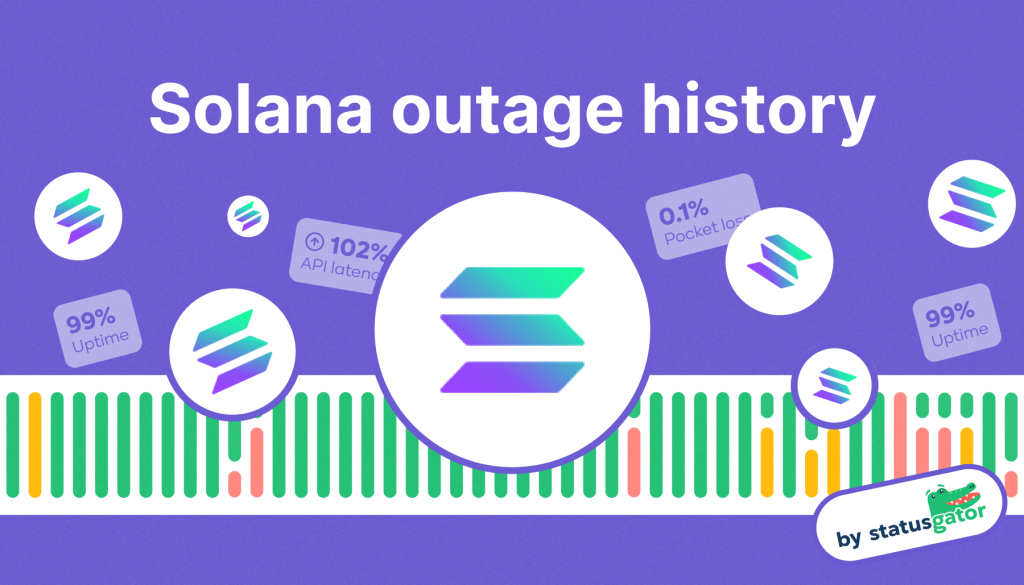
As illustrated in the incident timeline below, from October 2024 to February 2025, StatusGator noted at least nine distinct disruptions that impacted transaction processing, wallet transfers, and overall network performance. Some of these incidents lasted nearly 13 hours, yet they were never officially reported, revealing a lack of transparency.
So if you’re looking for independent status monitoring platforms to stay in the loop, try StatusGator. Stay up-to-date with the real-time insights into the reliability of Solana’s network.

February 6, 2024: Solana Mainnet Halted for 5 Hours
On February 6, Solana experienced a significant network outage. At 10:26 UTC, the entire mainnet halted for nearly five hours. The root cause of the outage was not officially confirmed at the time. But analysts, including Matthew Sigel of VanEck, speculated that a bug in the mechanism that deploys, upgrades, and executes programs on the Solana blockchain was to blame.
The Solana Foundation acknowledged the disruption and resolved it at 15:11 UTC when operations resumed.
February 25, 2023: Validator Broadcast Causes Major Downtime
A malfunctioning validator node triggered one of Solana’s largest single network outages at 1:31 UTC on February 25, 2023. The validator broadcast an unusually large block, overwhelming the network’s block-propagation protocol, known as Turbine.
The incident led to a sharp drop in network performance and several hours of degraded performance and partial unavailability. This outage incident highlighted the fragility of node-level behavior and Solana’s sensitivity to malformed inputs at the protocol level.
September 30–October 1, 2022: Bug in Fork Selection Logic
In late 2022, Solana’s mainnet was again impacted by an outage caused by a validator node malfunction. A backup “hot-spare” validator began producing duplicate blocks at the same height. A bug in the fork selection logic prevented other validators from building on top of the correct chain, causing the network to halt consensus and pause block production. This network downtime reinforced concerns about validator operations and the importance of network resilience.
June 1, 2022: Clock Drift and Consensus Failure
The Solana mainnet faced yet another outage due to a bug in the “durable transaction nonce” mechanism. Nodes produced inconsistent outputs, causing the network to lose consensus and halt block production. To compound the issue, the Solana blockchain’s internal clock was observed to be 30 minutes behind real-world time, further stressing time-sensitive decentralized applications and validator coordination.
April 30–May 1, 2022: NFT Minting Bots Cause Consensus Failure
A wave of transaction spam from NFT minting bots overwhelmed the Solana network, reaching a peak of four million transactions per second (TPS). The unprecedented volume exceeded network capacity, resulting in a network stall and loss of consensus.
The mainnet beta version had to be restarted to restore block production, underscoring Solana’s lack of robust defenses against spam attacks at the time.
January 21–22, 2022: Duplicate Transactions Flood the Network
The Solana network experienced another major outage when bots generated excessive duplicate transactions, leading to severe network congestion. The mainnet became unstable, and core services slowed significantly.
Although quickly resolved, this incident dealt another blow to network credibility and emphasized the need for more effective congestion-management mechanisms.
January 6–12, 2022: Degraded Performance from High Compute Transactions
Throughout the second week of January, Solana experienced degraded performance and partial outages due to high compute transactions that dramatically reduced the network’s throughput. Instead of the advertised 50,000 TPS, the Solana blockchain struggled to sustain even a few thousand TPS.
The event highlighted key bottlenecks in transaction processing and exposed limitations in Solana’s early network capacity assumptions.
September 14–15, 2021: IDO Overload Crashes the Network
In its first widely-publicized network outage, the Solana mainnet went down following an initial DEX offering (IDO) by Grape Protocol on Raydium.
Automated bots swarmed the network to farm token allocations, saturating validator nodes and pushing the system into a state where it could no longer maintain consensus.
Block production halted completely, requiring a coordinated restart by validators to recover. This incident remains a critical milestone in the history of Solana and signaled early warnings of vulnerabilities to transaction spam and bot activity.
Conclusion
The history of Solana outages reveals a recurring pattern of network congestion, consensus failures, and validator node malfunctions.
From September 2021’s memory overflow to February 2024’s unexplained halt in block production, the Solana network has experienced repeated periods of downtime, degraded performance, and even complete mainnet halts.
While the Solana Foundation continues to iterate on congestion-management mechanisms, fork selection logic, and client diversity, the blockchain’s mainnet still faces challenges in handling sustained transaction volume and network-wide stress.
Importantly, not all Solana outages are acknowledged officially. As demonstrated by StatusGator’s early warning signals, many incidents, such as wallet delays, transaction confirmation failures, and service degradations in 2025, were detected and monitored independently but never confirmed by Solana itself.
This reinforces the need for third-party monitoring solutions that offer real-time insight, historical network downtime data, and multi-service aggregation.
StatusGator monitors more than 5,000 cloud services, including blockchain platforms’ statuses like Solana, cryptocurrency exchanges, and decentralized applications, providing users with alerts, analytics, and historical context.
With features like Early Warning Signals, you can detect network outages and performance degradation even before they appear on official status pages.
Want to stay informed about Solana outages, your Web3 infrastructure, or critical cloud dependencies like AWS, Cloudflare, and Azure?
Try StatusGator for free and gain complete visibility into your stack’s reliability.


