On June 24, 2026, Shopify experienced a widespread service disruption that affected storefronts, admin dashboards, and merchant access across multiple regions. While the outage did not impact every user, reports quickly surfaced from merchants around the world who were unable to access stores, log in to administrative tools, or complete routine operations.
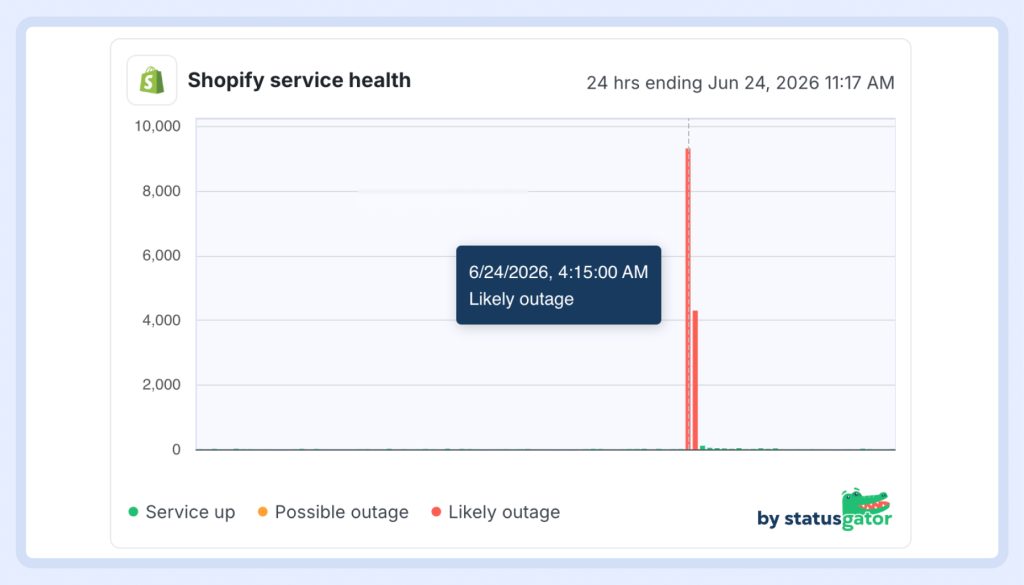
What makes this incident notable is how quickly StatusGator identified the problem. User outage reports began arriving at 11:15 UTC, and StatusGator’s Early Warning Signals system issued an alert at 11:16 UTC. Shopify did not publicly acknowledge the issue until 11:37 UTC after recovery had already begun, creating a 21-minute gap where organizations relying only on official status communications may have been unaware of a developing incident.
Timeline
11:15 UTC
- First outage reports begin arriving in StatusGator from Shopify users.
11:16 UTC
- StatusGator’s Early Warning Signals detects unusual outage activity and issues an alert.
11:20 UTC to 11:35 UTC
- Reports accelerate from users across North America, Europe, Asia, Australia, Africa, and the Middle East.
- Merchants report storefront failures, inaccessible admin panels, login issues, 502 and 504 gateway errors, and slow or unresponsive services.
11:24 UTC
- Some Shopify websites begin to come back online.
11:37 UTC
- Shopify officially acknowledges the incident.
11:48 UTC
- Final significant wave of outage reports arrives, indicating recovery is underway.
Impact
Based on user reports received by StatusGator, the outage affected multiple areas of the Shopify platform:
- Storefronts failed to load
- Merchant admin dashboards became inaccessible
- Login and authentication problems prevented access to accounts
- Users encountered 502 Bad Gateway and 504 Gateway Timeout errors
- Some merchants reported both customer-facing and backend systems being unavailable
The geographic distribution of reports suggests the issue was widespread rather than isolated to a single region. Reports arrived from locations including:
- United Kingdom
- United States
- India
- Spain
- Germany
- Denmark
- Australia
- Romania
- Malaysia
- Tunisia
- Ireland

Although not every Shopify customer appears to have been affected, the volume and diversity of reports indicated a significant service degradation.
What users reported
As reports came in from around the world, users described a variety of symptoms affecting storefronts, administration tools, and site availability:
“Storefront, admin and shopify.com not loading”
“Admin & storefront down”
“Unable to access admin”
“No access to front or backend”
“Store will not load”
“504 Gateway Time-out”
“NOT LOADING IN SPAIN ALSO”
“3 sites, admins, live site”
These reports began arriving before Shopify publicly acknowledged the incident and helped establish that the disruption was affecting users across multiple regions.
StatusGator insights
This incident demonstrates the value of crowd-sourced monitoring combined with intelligent detection.
In this case:
- First outage reports arrived at 11:15 UTC
- StatusGator generated an Early Warning Signals alert at 11:16 UTC
- Official provider acknowledgment came at 11:37 UTC
That means StatusGator identified meaningful outage activity 21 minutes before the provider publicly acknowledged the incident.
This type of detection is especially important during partial outages. Because the disruption did not appear to affect every user equally, traditional monitoring methods or provider-side checks may not immediately recognize the issue. User-generated outage intelligence can reveal patterns much earlier.
Organizations using StatusGator could see evidence of the developing incident while official channels still reported normal operations.
For ongoing visibility into Shopify reliability, see the:
Lessons learned
Partial outages can still have major business impact
Even when only a subset of users is affected, disruptions to storefronts, checkout flows, or administration tools can create significant operational challenges.
User reports provide valuable early intelligence
Customer experiences often surface problems before providers have completed internal investigations and published status updates.
Official status pages are not always the first signal
Many organizations rely exclusively on provider status pages. This incident highlights why independent monitoring sources are critical for obtaining faster awareness.
Geographic visibility matters
Reports from multiple continents helped confirm that the issue was not limited to a single ISP, region, or network path.
Conclusion
The June 24, 2026 Shopify outage serves as another example of how real-time outage intelligence can provide meaningful advance notice during developing incidents.
While Shopify acknowledged the issue at 11:37 UTC, StatusGator’s Early Warning Signals detected the outage at 11:16 UTC after analyzing incoming user reports from around the world.
For teams that depend on cloud services, SaaS platforms, and e-commerce infrastructure, those extra minutes can make a significant difference in incident response and customer communication.
Try StatusGator
Want to know about outages before providers acknowledge them?
StatusGator combines official status updates with real-time user reports and intelligent detection to help teams identify disruptions faster. Learn how Early Warning Signals can give your organization earlier visibility into developing incidents and help you respond before customers start asking questions.