
Released in 2021, Uptime Kuma is an advanced, self-hosted monitoring tool.
It offers a variety of monitoring capabilities, however, some users may look for an easier way to monitor multiple status pages, or a service that provides hosting.
To help these users explore relevant providers, we reviewed the 10 best Uptime Kuma alternatives in 2025. Below, we cover the key features of Uptime Kuma competitors. There’s also additional information to help you find the best alternative.
In case you are looking for a hosted alternative, check out StatusGator which has built-in website monitoring, status pages, and third-party status aggregation.
Overview of Uptime Kuma
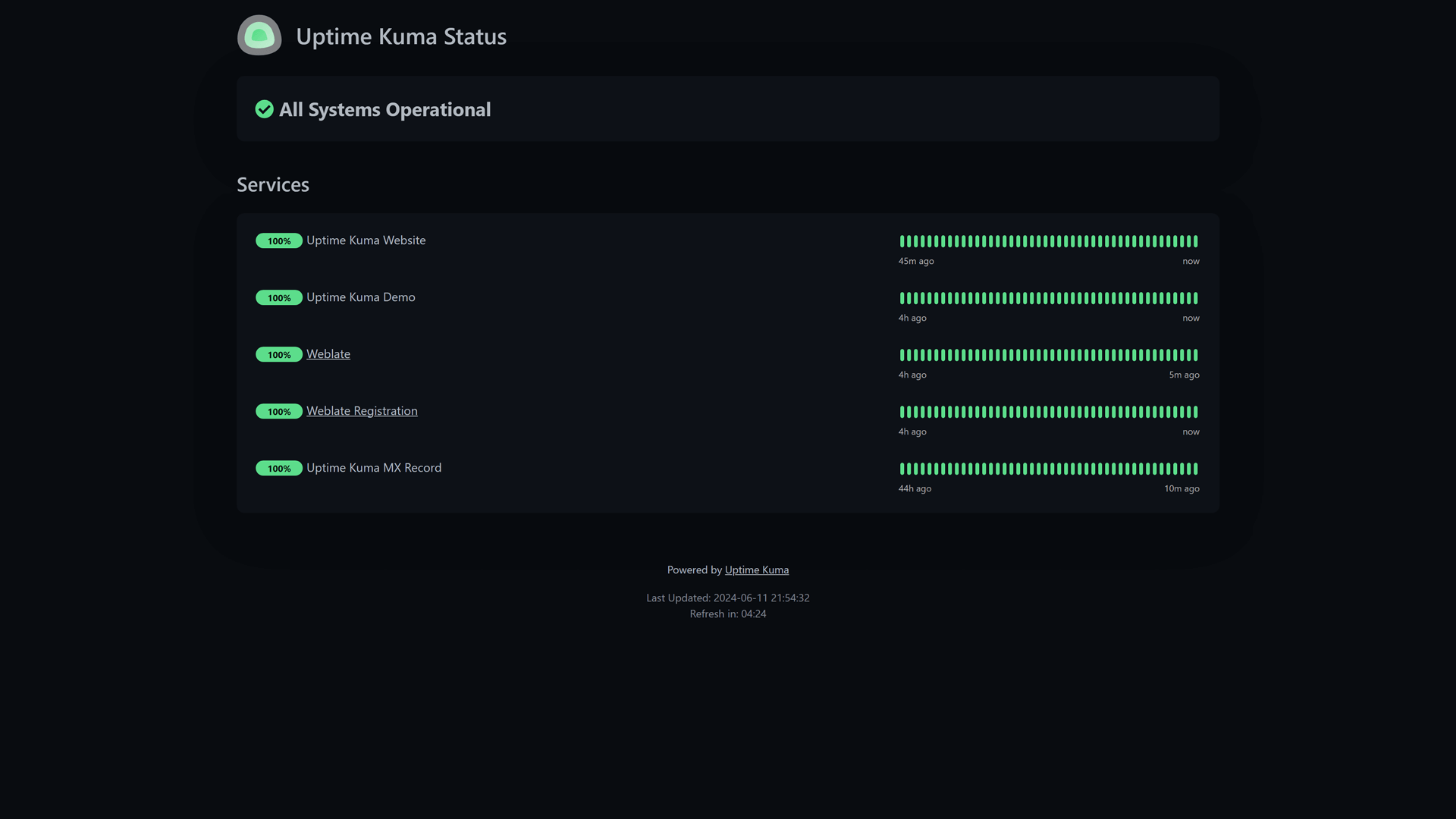
Uptime Kuma is a successor to other status page tools for GitHub, including Statping and Upptime.
Users can download it from GitHub. Specializing in uptime monitoring, Uptime Kuma is a free tool. Its users can add multiple monitors to their dashboards.
General monitors
- HTTP(s)
- TCP Port
- Ping
- HTTP(s) keyword
- JSON query
- gRPC(s) keyword
- DNS
- Docker container
- HTTP(s) browser engine (Chrome/Chromium) in Beta
Passive monitors
- Push
- Steam Game Server
- GameDig
- MQTT
- Kafka Producer
- Microsoft SQL Server
- PostgreSQL
- MySQL/MariaDB
- MongoDB
- Radius
- Redis
Also, Uptime Kuma allows users to generate multiple status pages to communicate the status data of their services, and it supports over 90 notification integrations.
Reasons to Explore Uptime Kuma Alternatives
Despite being a newer platform, the general sentiment about Uptime Kuma points to user satisfaction.
Yet, some look for alternatives to Uptime Kuma for particular features, monitoring potential, integration capability, and more.
For example, you need a status page that displays the status of services of your dependencies. Building such a page with Uptime Kuma might require resources you do not have.
Thus, StatusGator offers a quick setup with a GUI. There’s an option to choose from 4,100+ cloud services and vendors to display all the dependencies’ statuses on a single IT status page.
Criteria to Consider When Looking for Uptime Kuma Alternatives
When considering alternatives to Uptime Kuma, there are a few questions to ask yourself.
- What type of monitoring do you need?
Alternatives offer public status pages, private status pages, and aggregated status pages. Some also provide audience-specific status pages like StatusGator and Statuspage. Uptime Kuma offers free website monitoring, and protocols including HTTP(s), ping, and Docker containers. Some alternatives might not. So always check if your tool has the appropriate monitoring capability.
- What requirements do you have?
What services do you wish to monitor? What kind of security requirements do you have? Integration capability is also a key consideration when choosing an Uptime Kuma alternative.
- What features do you need?
Check out if the alternative supports additional features you miss in Uptime Kuma.
Hosted and Open-Source Uptime Kuma Alternatives
1. StatusGator

While Uptime Kuma focuses on self-hosted monitoring and a wide range of monitor types, StatusGator excels in aggregating official status data from third-party providers. StatusGator provides a hosted solution for monitoring the status of over 4,800 cloud services, making it an excellent complement to tools like Uptime Kuma. This capability allows users to see the status of cloud services like AWS, Cloudflare, and many others alongside their website monitors.
Key Monitoring Features of StatusGator:
- Service Monitor (Third-Party Monitoring): StatusGator aggregates status data from over 4,800 cloud services and SaaS providers such as AWS, Zoom, GitHub, and Stripe. This feature ensures you are always aware of the operational status of the services you depend on.
- Website Monitor: StatusGator continuously checks your website’s availability and performance, providing instant notifications in case of any issues.
- Custom Monitor: StatusGator allows you to manually publish incidents on your status page.
Also, the following features are available for users to enhance IT systems and website monitoring.
Public and Private Status Pages: Public pages inform your users and customers about the status of your services, while private pages keep your internal team updated on all your cloud providers and systems.
Early Warning Signals: StatusGator’s advanced algorithm analyzes thousands of data points to identify potential service disruptions. It provides proactive alerts about issues with your critical dependencies, helping you stay ahead of outages.
StatusGator even tracks services that lack a public status page, ensuring you stay informed about downtime that would otherwise go unnoticed. If you rely on Paychex or TriNet, you can proactively monitor their availability with our Paychex status and TriNet status page—giving you full visibility without the guesswork.
Instant Notifications: Users receive real-time updates via Slack, MS Teams, email, SMS, webhooks, and APIs. This ensures your team is always informed and can respond swiftly to any incidents.

StatusGator’s main advantage lies in its ability to monitor third-party providers, providing insights into whether issues with external services are affecting user websites. It also allows the creation of status pages with monitors, similar to Uptime Kuma, but with the added benefit of including third-party service status. Many users find value in using both tools together to cover all their monitoring needs.
Pros: Custom monitors, status monitoring of 4,800+ services, aggregates third-party service status, improved communication with public and private status pages, is a hosted solution.
Cons: Monitors are not so versatile focusing more on the cloud services’ statuses, which makes StatusGator an excellent complement to tools like Uptime Kuma.
2. Upptime

Similar to Uptime Kuma, Upptime is a free, open-source monitoring solution. It’s an Uptime Kuma alternative that can be downloaded as a file on GitHub.
Upptime is an open-source status page tool alongside the more well-known tools. It was initially released in 2020. The platform offers analytics, response time metrics, built-in notification support, incident reports, and interval monitoring every 5 minutes.
No server is required as data is pulled from Upptime’s GitHub repository and URL scans. DNS and ping checks can also be carried out.
Pros: Powered by GitHub, provides service metrics, no server required.
Cons: Limited on-page customization, no filtering for incident history, limited integrations.
3. Vigil
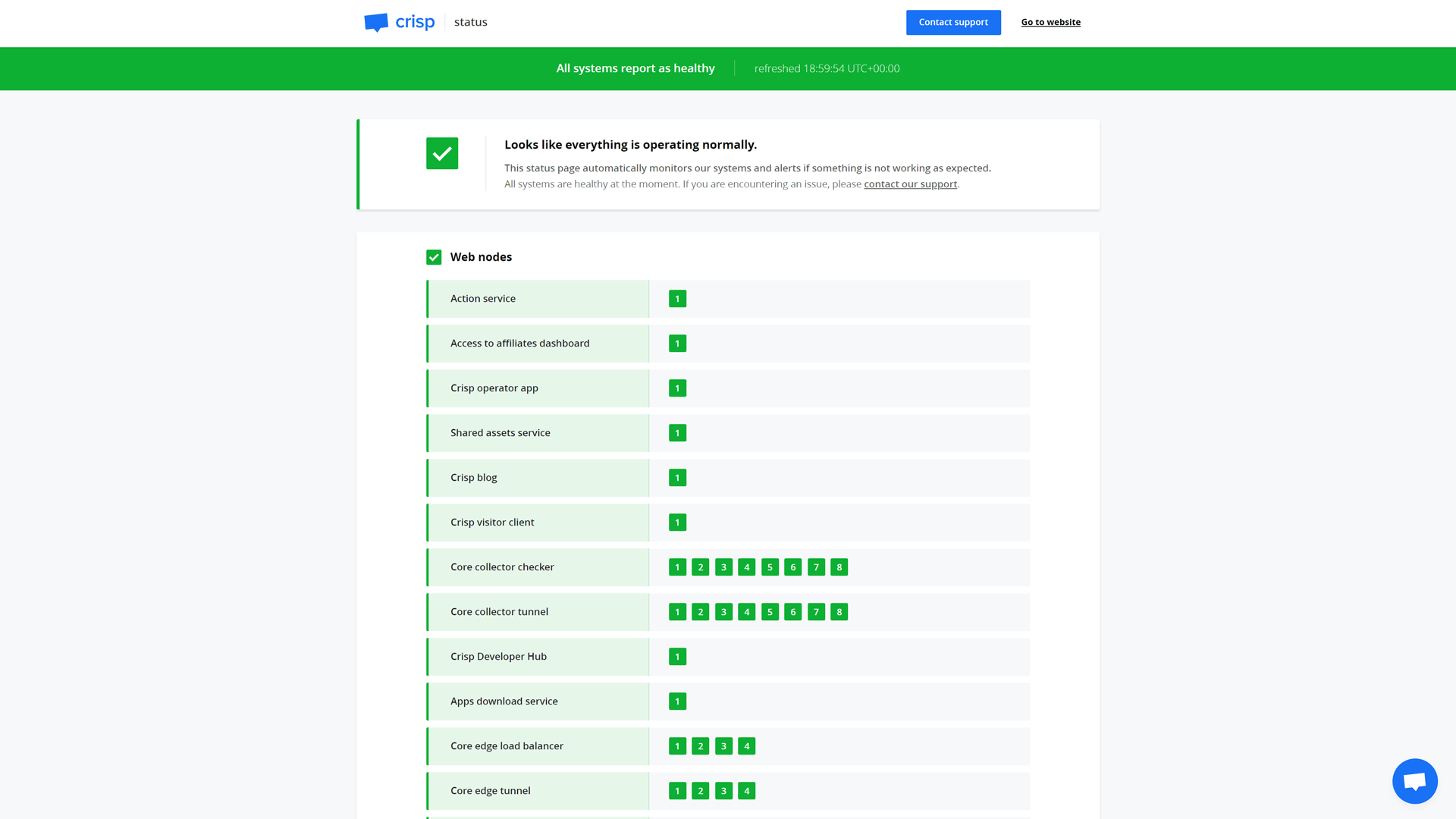
Vigil is a self-hosted and open-source status page system. This alternative to Uptime Kuma was originally built in Rust. It supports various monitoring methods. One is poll probes, which periodically check the status of services. The other is push probes, which receive health data from applications.
Furthermore, Vigil includes three status states: healthy, sick, and dead. The platform provides real-time notifications via channels like Slack, SMS, and email. Their monitoring also covers HTTP, TCP, and ICMP services.
Pros: Notification flexibility, service health categorization, various monitoring methods.
Cons: As a command-line tool, it can be difficult to set up if users are unfamiliar with it.
4. UptimeRobot
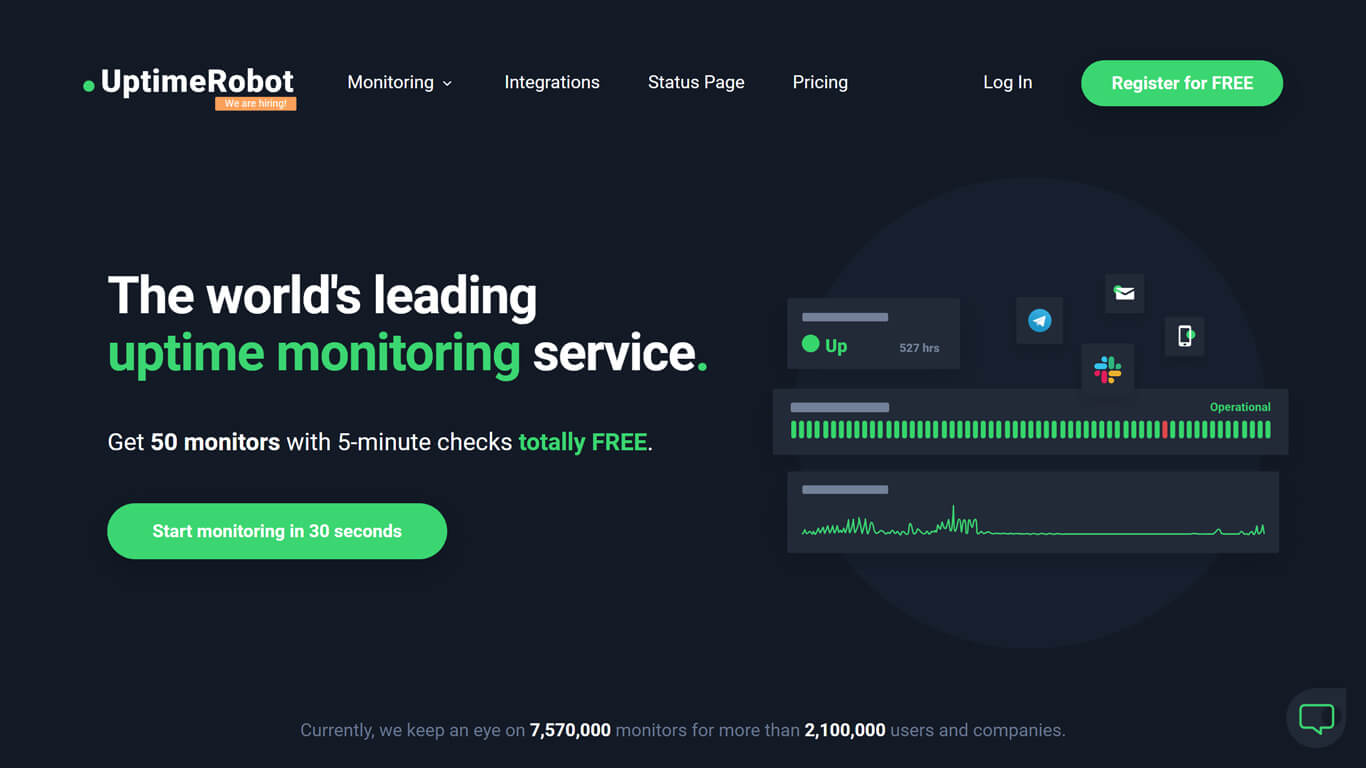
UptimeRobot is another popular alternative to Uptime Kuma, but it’s not open-source. The tool has a range of features included in one simplified platform. Some popular companies that use UptimeRobot are GoDaddy, NASA, and Expedia.
UptimeRobot offers website monitoring, and also ping/port, cron, and keyword monitoring. It also covers basic notifications and customization. There are basic third-party integrations, email and SMS notifications, API, and 2FA. They also have a mobile app.
Their paid plans are also affordable and offer more features. However, UptimeRobot’s free plan is a popular Uptime Kuma alternative due to its simplified, all-in-one experience.
Pros: Basic integration, notification, and customization support.
Cons: Limited features, only one status page, three months of data retention.
5. Cachet

Cachet is amongst the more popular open-source Uptime Kuma alternatives. It is powered by Bootstrap 3 and is used by popular brands such as Sky, Boeing, and Bosch to name a few.
While offering uptime monitoring, Cachet’s key feature (the comparison of Cachet vs Uptime Kuma) is that it utilizes a JSON API to automate processes.
This automation can perform routine tasks and maintenance and is a useful feature for a monitoring tool. Metric customization, maintenance schedules, and incident reports are included with a free plan.
However, it requires a PHP backend to run a status page, which could be an issue for some.
Pros: Bootstrap 3 powered, JSON API for automation, metric customization.
Cons: It requires a PHP backend and has limited on-page customization.
6. cState
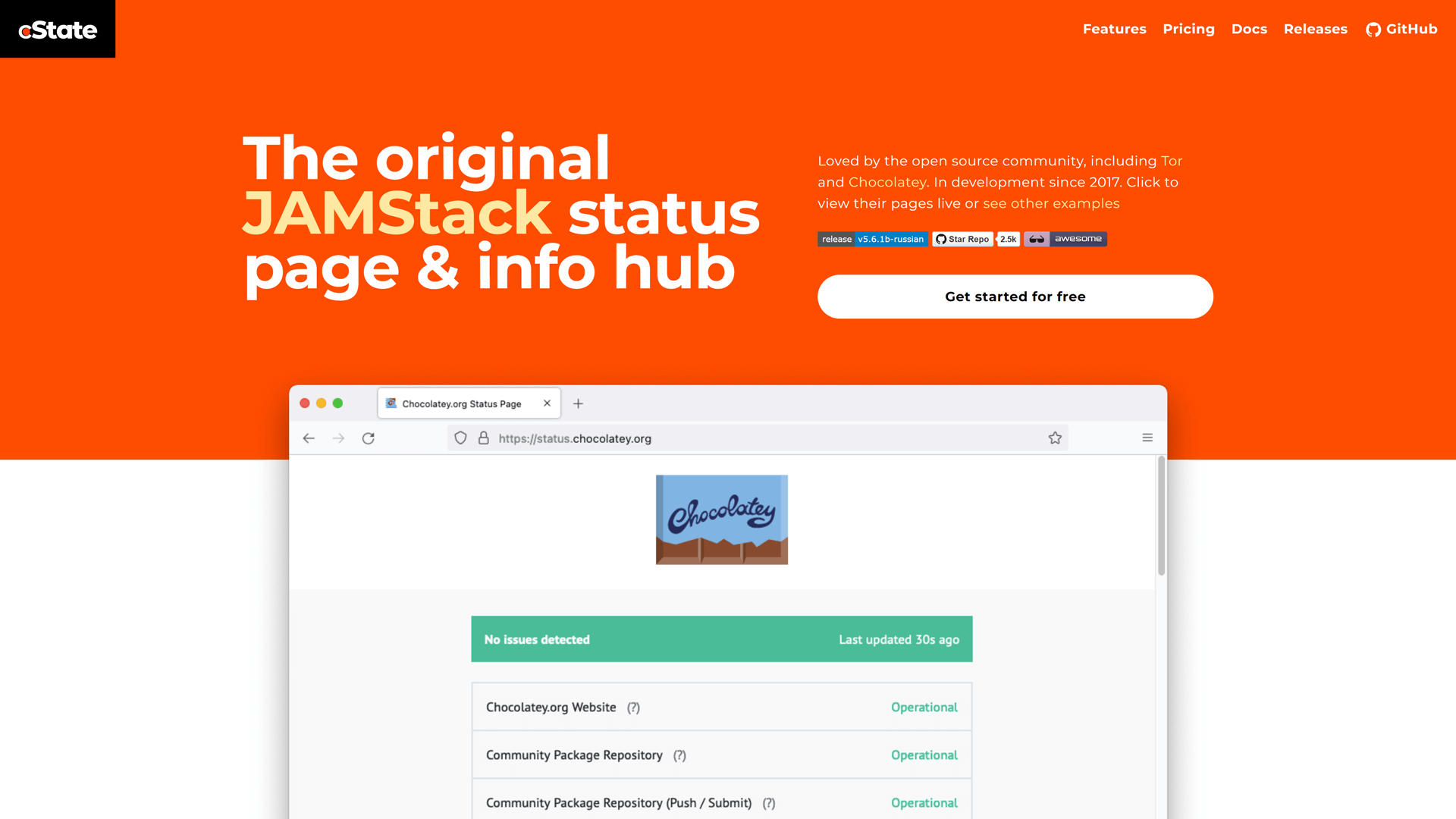
cState is a serverless, open-source Uptime Kuma alternative similar to Upptime and Vigil. Launched in 2018, it provides users with a customizable status page system designed for organizations of all sizes.
One key feature includes an adaptable design UI that can be customized from a single file or settings page. The tool offers dark mode. Other features include statistical calculations for key metrics, such as issue resolution time, and detailed incident reports. Built-in support includes English, German, and French.
Pros: Open-source, customizable status pages, multi-lingual support.
Cons: Time-consuming setup to tailor customization.
7. Monitoror
Monitoror is a unified monitoring system that describes itself as a wallboard app. It allows users to track server status and CI build progress.
Key features include customization options for the UI and configuration, ensuring it meets specific user needs.
It is noted for its reliability and ergonomic design, as well as customization features such as dark mode and wallboard design. Monitoror is free to download and is available for Linux x64, Linux ARM, Windows x64, and macOS.
Pros: Unified monitoring, ease of use, and free download.
Cons: Limited integrations, documentation, and support.
8. Pingdom
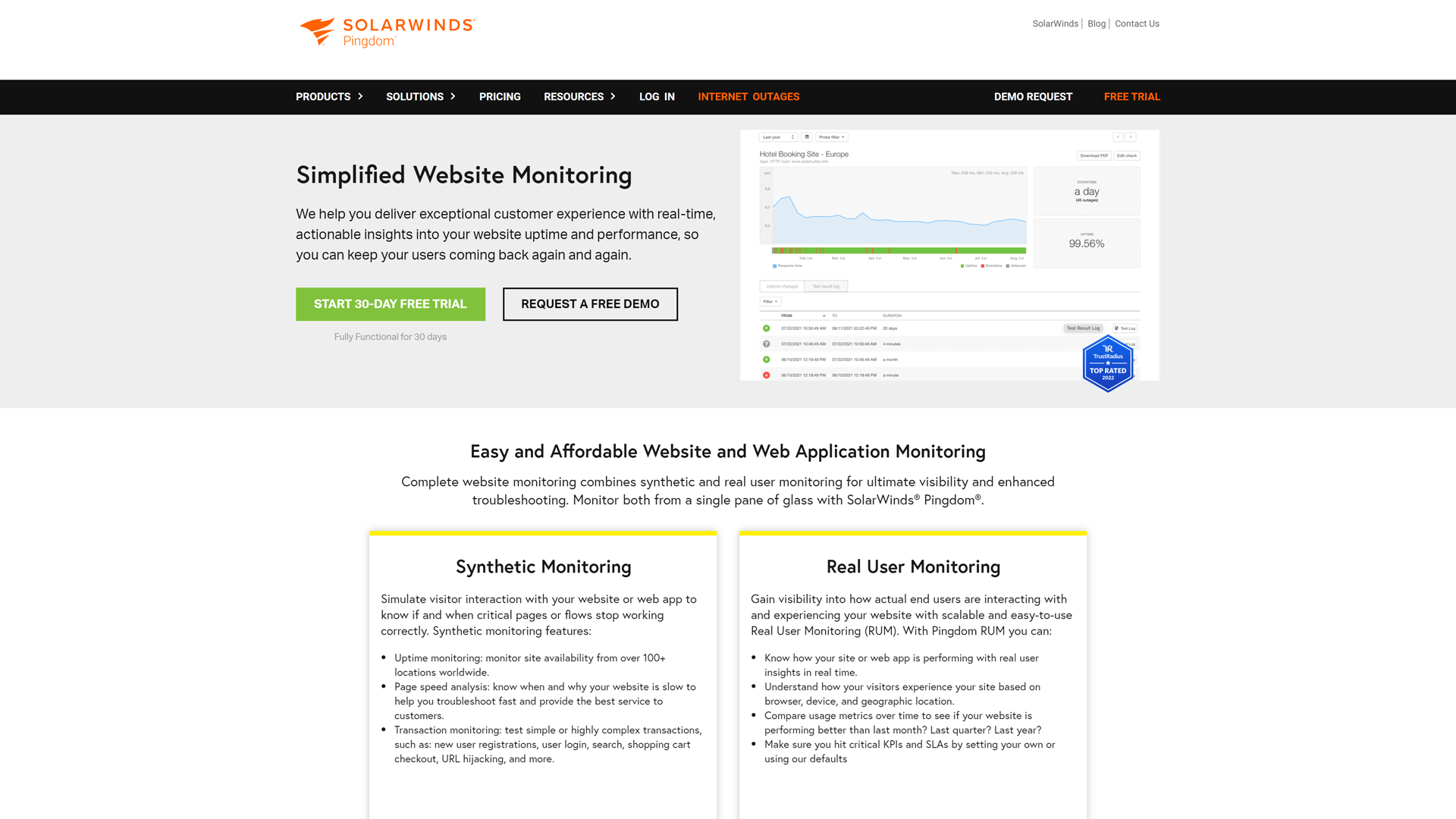
Pingdom is amongst the more popular Uptime Kuma alternatives on this list. It offers uptime monitoring, real user monitoring, and synthetic interaction testing. It allows users to track website performance and identify issues.
Pingdom offers detailed performance reports and customizable alerts to notify users of any performance issues. Pingdom also provides comprehensive dashboards and reporting tools to help analyze and improve website performance.
Pros: Comprehensive monitoring, real user insights, customizable alerts.
Cons: Higher pricing for advanced features.
9. Cabot

Despite being an open-source system, Cabot’s official description explains that it “provides some of the best features of PagerDuty, Server Density, Pingdom, and Nagios without their cost and complexity”.
Users can set up a self-hosted monitoring and alerting system designed to track websites and infrastructure.
Cabot monitors Graphite metrics, Jenkins jobs, and web endpoints, aggregating related triggers into services and instance dashboards. It alerts support staff to issues via phone, SMS, Hipchat, or email notifications. Cabot is free to use and can be deployed quickly.
That said, the description also states that Cabot is not actively maintained, which could be an issue for users if they encounter problems.
Pros: Self-hosted, comprehensive monitoring, multiple alert options.
Cons: Requires setup and maintenance.
10. Pulsetic

Pulsetic is a website monitoring service that allows startups, e-commerce, and developers alike to set up a monitoring system simply and quickly.
Pulsetic offers customizable public status pages, regional monitoring to localize downtime and detailed performance reports. Users can personalize alerts, status badges, and request settings, as well as monitor SSL certificates. Pulsetic provides a free plan with up to 10 monitors, unlimited status pages, and custom domains.
Pros: Customizable alerts and regional monitoring.
Cons: Limited integrations, limited documentation, and support.
Best Practices for Choosing the Right Uptime Kuma Alternative
There are a few things to consider when finding the right Uptime Kuma alternative.
Considerations for Number of Monitors and Locations
When considering Uptime Kuma alternatives, you should evaluate the number of monitors you need and the global monitoring locations. It ensures comprehensive coverage of all areas relevant to your services and accurate detection of incidents across different regions.
Analyzing Outage Management and Incident Response
Detecting incidents and alerting your users aren’t the only key aspects of a robust monitoring system. Plans for incident response and outage management matter just as much.
Assess how the Uptime Kuma alternative you’re considering handles outage management and incident response. Look for features like automated alerts, detailed incident reports, and real-time status updates to ensure efficient issue resolution.
This is especially true for open source Uptime Kuma alternatives.
Integration Capabilities with Other Monitoring Services
Additionally, integration capability is a crucial aspect to consider when implementing Uptime Kuma alternatives. Check the integration capabilities with other monitoring tools and services you rely on to ensure compatibility.
Seamless integration helps consolidate data, streamline workflows, and provide a more comprehensive view of your infrastructure’s performance.
Summary
Finding an Uptime Kuma alternative all depends on your requirements.
However, if you are looking for an alternative, there are a variety of monitoring solutions, including hosted solutions and status page aggregators.
Before you commit to an alternative, however, consider whether you want a free and open source tool, such as Upptime, Vigil, or Cabot. Another option is a hosted monitoring platform such as StatusGator, UptimeRobot, or Pulsetic. Also, keep in mind integrations, notifications, the number of monitors, analytics, and other crucial factors.
With this in mind, we’re sure you can find the right Uptime Kuma alternative for you!

FAQ
What is the best Uptime Kuma alternative?
The best Uptime Kuma alternatives are Upptime, Cachet, and StatusGator. The choice depends on your system’s requirements and monitoring needs. To find the best alternative for you, look at what each alternative offers and see how effective these features are compared to Uptime Kuma. Consider the number of monitors you need, customization, notifications, and more factors to find out what works for you.
What is the difference between Uptime Kuma and Uptime Robot?
The difference between Uptime Kuma and Uptime Robot is that Uptime Kuma is an open-source system that is free to download on GitHub. While Uptime Robot is also free, it is not open-source and is targeted at enterprises looking for simple monitoring.
Why do I need an Uptime Kuma alternative?
You might need an Uptime Kuma alternative to use the tool, which has unique features that might be useful. For example, StatusGator has a status page aggregation feature that allows you to see all your cloud dependencies on a single board.
What database does Uptime Kuma use?
Uptime Kuma uses a local SQLite database for their services.
Is Uptime Kuma free to use?
Yes! Uptime Kuma is free to use. You can get it from the GitHub repository.