
StatusGator vs. other status aggregators

StatusGator invented the status page aggregator more than 12 years ago, and we're still the best. Over the years, many clones have emerged, but none operate at our scale or sophistication. All of them fail to match our comprehensive coverage, early detection capabilities, and enterprise-grade features. If you rely on third-party services, there's no better choice.
Schedule a demo
How StatusGator is different
StatusGator is the enterprise-grade status aggregator built for teams that rely on third-party services. All other status page aggregators are playing catch-up.


 Other tools
Third-party service monitoring
Massive coverage of external dependencies
Monitors 13,090+ third-party services (cloud platforms, APIs, SaaS tools) via official status pages and crowdsourced reports.
Limited vendor visibility
Track fewer services (often a few thousand) and rely mainly on official status pages – offering less comprehensive coverage.
Early outage detection
Early Warning Signals
Our Early Warning Signals detects thousands of outages in advance of official status pages due to our size, scale, and enterprise customer base.
Standard update alerts
Most have no early outage detection, or very limited in scope.
Unified status page
Customized all-in-one status page
Combines your site's health, vendor statuses, and manual updates into one easy-to-read page.
Basic aggregated feeds
Often show only third-party status without combining internal incidents or custom status monitors.
Custom monitors & incident updates
Incident management built-in
Add your own custom monitors and log incidents manually or automatically, then display them alongside service statuses.
No internal override controls
Usually lack tools to log custom incidents or internal status, focusing only on external vendor updates.
One subscription
Monitoring included out of the box
Offers built-in website uptime checks, ping, HTTP monitors, and custom alerts – no need for a separate monitoring tool.
Aggregation only, no monitoring
Most status aggregators are limited to aggregating public status pages, without native direct monitoring which means you get no 'single pane of glass'.
Is StatusGator right for you?
Situations where StatusGator may not be the perfect match.
Watching just a service or two
If you only need to casually keep an eye on a couple of vendors, a free tier on a lightweight aggregator may be enough to get started.
Consumer service focus
If you specifically want "is it down right now" crowd-sourced reports for a few mainstream consumer apps, a tool like DownDetector is built around that single use case.
No history or reporting
If you only care about right-now status and never need uptime history, SLA reporting, or audit trails across your vendors, a simpler aggregator may suffice.
No external dependencies
If your systems are entirely self-hosted with no third-party APIs or platforms behind them, there are simply no vendor statuses for us to aggregate.
Schedule a free 30-min demo
We'll show how StatusGator can benefit your team. No strings attached.
Frequently asked questions
-
How is StatusGator different from newer aggregators like IsDown or EagleStatus?
StatusGator invented the status page aggregator category over a decade ago, and we've been refining it ever since. Newer tools are largely thin wrappers around public status feeds. We run a mature, enterprise-grade platform that pairs the broadest service coverage in the industry with built-in monitoring, early detection, a customizable status page, and the support and reliability that serious teams depend on. -
Why does StatusGator detect outages earlier than other aggregators?
Early detection is a function of scale, and scale is hard to copy. StatusGator's Early Warning Signals draw on a massive base of users and millions of web impression, so we frequently surface issues before the official incident is even posted. Smaller aggregators simply don't have the audience or check volume to detect outages early -- they're mostly relaying what the vendor already announced. -
Does StatusGator offer enterprise-grade support and reliability?
Yes. StatusGator is built for teams that can't afford to guess. We provide responsive enterprise support, a proven track record across thousands of organizations, SSO, security and audit controls, and the operational maturity that comes from running this platform at scale for years -- not something a small or newly-launched competitor can match. -
How comprehensive is StatusGator's service coverage?
We monitor thousands of third-party services (cloud platforms, APIs, and SaaS tools) using both official status pages and crowdsourced signals. That's a meaningful multiple of what most aggregators track, so you're far less likely to hit a gap in coverage for a vendor your stack depends on. Our full-time team maintains hundreds of integrations in real time with 24/7 on-call coverage. -
Can I build my own status page on StatusGator?
Yes. You can publish a fully customizable public or private status page that combines your internal systems, the third-party services you rely on, and manual incident updates—all in one place, not just a raw aggregated feed. -
Does StatusGator monitor my own uptime too?
Absolutely. We include built-in website uptime, ping, and HTTP monitoring, so your own systems and your vendors live on a single pane of glass—no separate monitoring tool required. -
Can I integrate StatusGator with Slack, Teams, and our other tools?
Yes. You can stream alerts into Slack, Teams, email, webhooks, PagerDuty, and more, and pull data through our API to keep every team and system updated in real time.
Can't find your question? Email us to arrange a time to discuss. We'd love to chat!
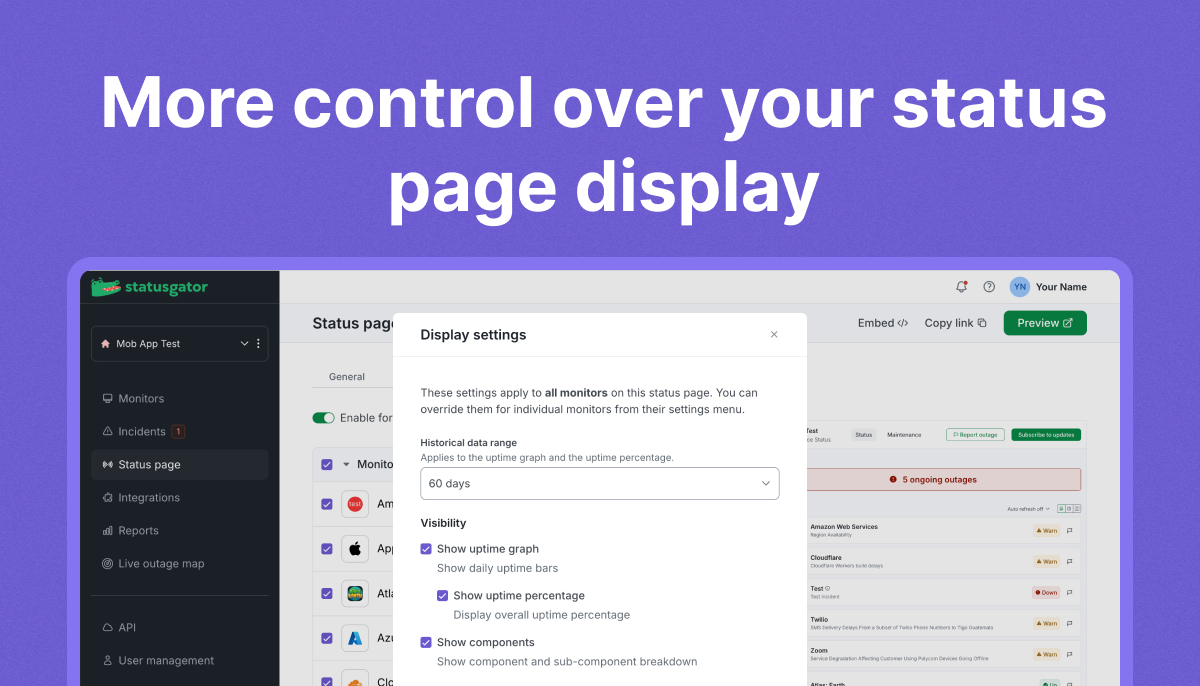 More control over your status page display
 More flexible color customization for status pages
 Phone numbers now supported in status page contact field